DeFi Saver Newsletter: March 2026
In this issue, we’ll cover the Ethereum Strawmap, key DeFi Saver updates, highlights from ETHDenver and Consensus, and a look at how DFS automation helped users save millions in liquidation fees.
Welcome to the latest DFS Newsletter, where we recap all the latest DeFi developments and DFS updates for the previous month!
We all know that the events season kicks off in February, and with our first few travels done, it’s been great to set the tone for the year ahead, with the rest of the DeFi community.
So, before we dive in, let’s go over the topics:
- The 2029 Ethereum roadmap;
- DFS news and updates: Aave v4 is on the way, new markets and automations & upcoming updates;
- A lookback on ETHDenver and Consensus events;
- 2026 DFS Stats for liquidation protection;
- Community shoutouts.
Ethereum roadmap to real DeFi
Over the last year, there has been a significant shift in the way institutions perceive DeFi, and their simultaneous effort to gradually increase their involvement in the space. We saw new, groundbreaking regulations take place, and banks, asset managers, and fintechs exploring on-chain settlement systems and decentralized liquidity markets.
It’s evident that the conversation about DeFi is changing, leaving many to wonder in what way the ecosystem will develop moving forward, and whether DeFi (and Ethereum) will stay true to its founding values.
In one post on 24 February, Vitalik addressed this concern by stating that the Ethereum Foundation is keen on seeing DeFi thrive, but as a permissionless, self-custodial, open source, uncensored, and privacy-first ecosystem.
Defi is a central part of the value that Ethereum provides. Financial empowerment is a central part of what it means to have agency and freedom in our current world. Finance is far from the only thing that Ethereum is good for, but it is an important thing. This post discusses… https://t.co/BGDRqrfUlI
— vitalik.eth (@VitalikButerin) February 24, 2026
To add to that, the Ethereum Foundation has also presented the Strawmap, an outline of infrastructure development to be achieved by 2029. The draft in question aims to address five key objectives: near-instant tx finality, built-in privacy, quantum-resistant security, closer L2 integration, and increased throughput.
A very important document. Let's walk through this one "goal" at a time. We'll start with fast slots and fast finality.
— vitalik.eth (@VitalikButerin) February 25, 2026
I expect that we'll reduce slot time in an incremental fashion, eg. I like the "sqrt(2) at a time" formula (12 -> 8 -> 6 -> 4 -> 3 -> 2, though the last two… https://t.co/ni9wIF2BgJ
And as the name suggests, the Strawmap is simply a proposal subject to debate, not a proposal set in stone. Nevertheless, it not only gives insight into what will be developed, but also how: Vitalik speaks of the Ship of Theseus* approach, meaning the system will be upgraded component-by-component, to ensure the process is clean and not in the least disruptive to the user.
*A note for the curious: According to Plutarch, the ship of Athenian hero Theseus was preserved for centuries by gradually replacing decaying wooden planks one by one, with the cargo unscathed. So, the phrase is used to pose the question: if you replace all the planks, is it still the original ship?
DeFi Saver news & updates
Over the past month, our team has been busy expanding support for new users, improving security across the platform, and engaging with the DeFi community at ETHDenver and Consensus conferences.
Summer.Fi Pro has officially transitioned to DFS
As we have already mentioned in our previous issue, as of February 12, all Summer.Fi automation was suspended, and the app has officially been sunset. This means that as of now, DeFi Saver is the sole platform for managing all Summer.fi positions.
Summer․Fi Pro has now been fully shutdown, including their automation services.
— DeFi Saver (@DeFiSaver) February 12, 2026
As a reminder, all Summer․Fi Pro positions are already available and manageable in DeFi Saver.
⚠️Summer․Fi automation users specifically are recommended to set up DFS Automation as soon as… https://t.co/xskm3Zv6bN
Apart from the upcoming Lazy Summer vault integration that is in the works, we’ve received direct user feedback to integrate some additional Morpho markets.
So now, some of the newly supported Morpho markets on DFS are USDe/USDtb, ETH/USDT, rsETH/ETH, rswETH/eth, and weETH/ETH for Mainnet. And wstETH/EURC, cbETH/EURC, weETH/ETH, as well as AERO/USDC markets for Base. If by any chance we did not name a market you are specifically interested in, you can easily check whether we support it via the DFS Discover feature.
And if you are a SummerFi Pro user reading this, we’d love to hear any feedback you have thus far, so please feel free to join the DFS Discord and find us there.
Security updates for Safe users
On 3 February, it was brought to our attention that a large-scale scam attempt was taking place, aimed at Safe multisig users.
Attackers would use a vanity address generator to create a Safe wallet with the same four starting and ending characters as the user's own wallet. They would then add that target as one of the signers, in the hope that they would transfer funds to the wrong Safe wallet owned by the malicious actors.
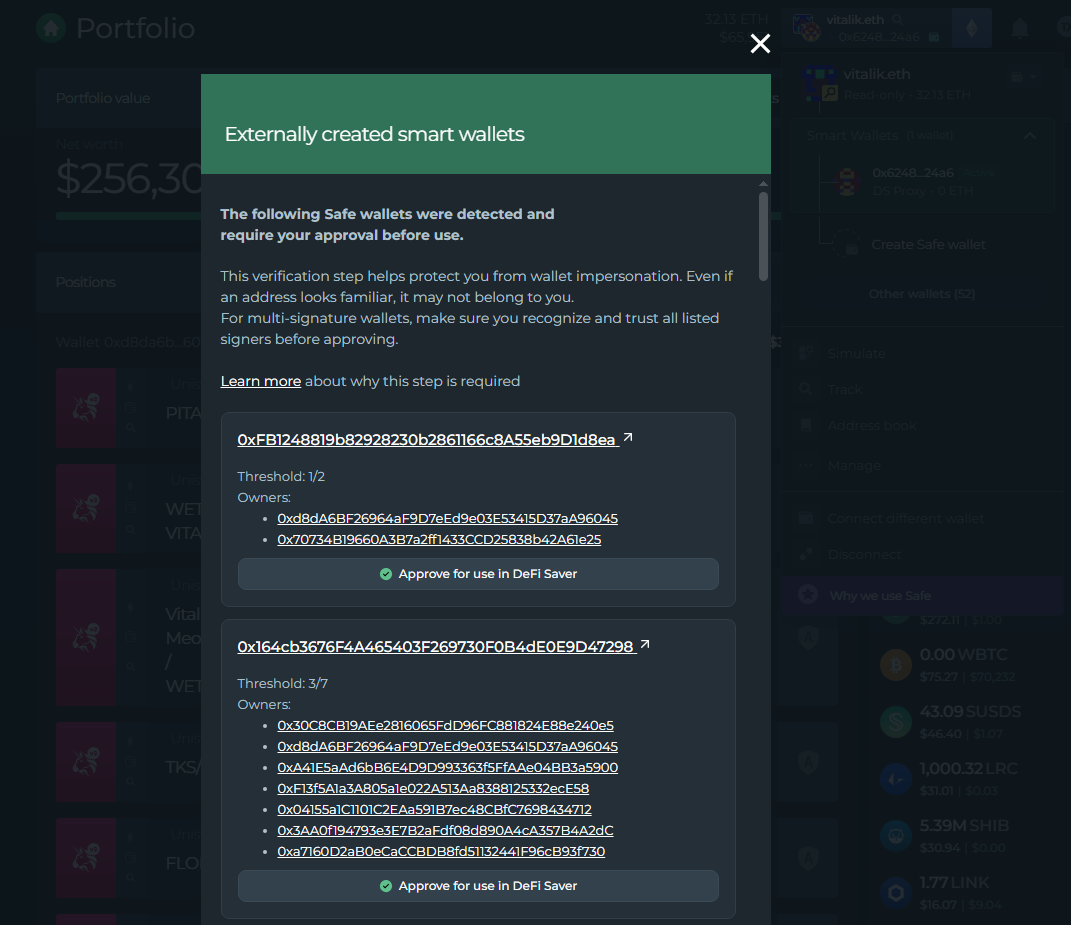
To mitigate this risk, DeFi Saver now only shows 1/1 Safe wallets created directly through DFS by default. Any other Safes (multisigs or not) can still be confirmed and added manually.
Events, events, events
As mentioned in our previous issue, the DFS team went to Consensus Hong Kong (10-12 February) and ETHDenver (17-22 February), almost simultaneously.
And if you’ve missed us on either of these continents, you will certainly find us at this year's EthCC, from 30 March until 2 April, in the beautiful city of Cannes.
Defi Saver goes to Hong Kong
Since it was our first time attending a Consensus event, we asked our team member, Natasha, for a few of her insights:
“It was interesting to see how strong the institutional presence was at the event. Many of the conversations revolved around real-world assets (RWAs), tokenization, and the operational side of stablecoins, with a lot of attention on governance, compliance, and how these technologies are moving toward real-world adoption.
What's happening?
— Natasha Bujosevic (@defisaver_nat) February 10, 2026
Hong Kong is happening
I'm obsessed with this city 🇭🇰#ConsensusHK2026 pic.twitter.com/sixBO6byWk
Agentic finance also came up frequently in DeFi-related discussions, suggesting that this is a theme many teams are actively exploring.
More broadly, the event highlighted how Asia continues to position itself as an important hub for digital assets, with Hong Kong’s regulatory clarity playing a significant role in attracting institutional participation.’’
Defi Saver goes to Denver
This year’s ETHDenver left us with some major inspiration on what to focus on next. Between conversations with curious visitors and insightful chats with long-time DFS users, we walked away with a lot of cool ideas about where things should go from here.
GM @EthereumDenver!🌄
— DeFi Saver (@DeFiSaver) February 18, 2026
The main event is officially underway and for the next four days you can find us at the DFS booth in the New France Village.
Plenty of us here for chatting - and plenty of exclusive merch to grab.👀
See you at the venue! pic.twitter.com/IXCRt2M5yH
And then there were those of you who came just to pat us on the back for everything we are already building. Here are some of the comments that stood out the most:
"You guys saved my ass more times than I can count"🛟
— Alex (@defi_alex23) February 24, 2026
"Someone told me to migrate to @DeFiSaver, I did, and wow! The UI is a piece of art!"
"We were just talking about how it would be nice to have these tools. Had no idea they already existed."
Just some of the comments that… pic.twitter.com/FXslyhOCk4
It’s always motivating to hear that DFS actually makes a difference in how people interact with DeFi, and a big thanks to all of you who dropped by to chat with us, both at Consensus and ETHDenver.
DeFi Saver stats
Last month, we analysed some of the key DFS metrics related to the infamous February liquidation wave that wiped out around $5B in the crypto space.
This made us want to take a closer look at how big an impact DFS has in protecting users from liquidation in times like this, and how much users have actually saved, using DFS.
In this case, when we say liquidation protection, we are specifically referring to Automated Repay. Moreover, please keep in mind that the presented numbers account solely for the most commonly used protocol on DFS, Aave. We’ll show the number of users whose Automated Repay was triggered for the given period from 25 January until 9 February, as well as the amounts the users would have paid in fees, had they not used DFS Automation.
Here is what we found:
- There are a total of 382 wallet owners whose Automated Repay got triggered in this given period. Around 95% of those users have a Safety ratio below 150%, meaning people usually automate risky positions;
- 98% of users who had Automated Repay triggered had opted not to close their positions;
- The most popular token pairs used in these kinds of positions are wstETH/USDT (Mainnet and Arbitrum), ETH/USDC (Base and Optimism);
- Had they not had automated parameters in place, these users would have paid $8.4M in liquidation fees, whereas with DFS, the total amount they paid was $701k. Therefore, the total amount saved is around 91.6%.

And what makes us even happier than seeing these numbers is the direct feedback from our trusty DFS community. We hope you found these segments helpful, and remember our support team is here to help with any questions you might have about protecting your positions via DeFi Saver.
Position of the month
Over the past few months, we’ve realised a certain pattern: many of our users stick to just a handful of tools DFS has to offer. While it’s great to see, it also sheds light on the fact that many are not aware of the full range of tools available on the app.
So, for this month's segment, we’ve decided to highlight a handy DFS feature that might go unnoticed: DCA (Dollar Cost Averaging) orders.
It serves as a mechanism to periodically increase your exposure to a certain asset.
Unlike Limit orders, which execute when a certain price is reached, DCAs allow you to gradually invest a fixed amount into a specific asset, at regular time intervals, regardless of its current market price. By spreading out the purchases over time, you reduce the need to time the market.
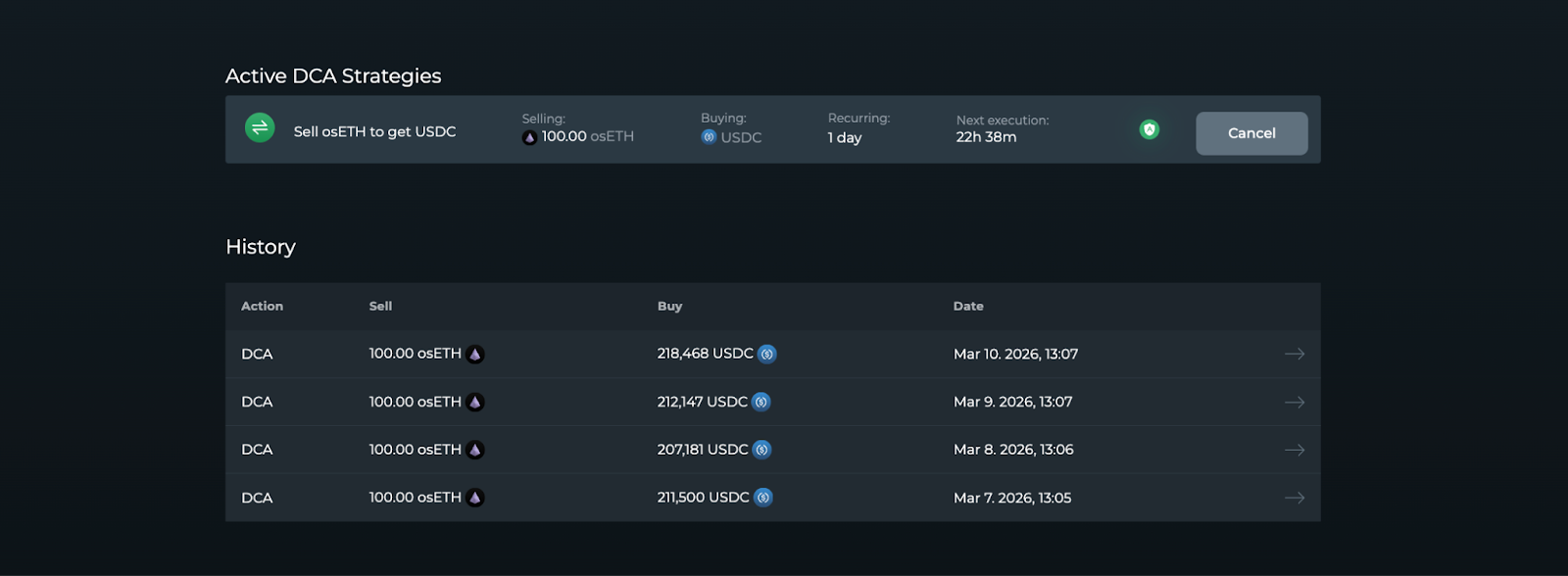
Take this 0x2585 user for example. He wishes to decrease his exposure to osETH, probably due to high market volatility in the past couple of weeks. Instead of exiting all at once, they used a DCA order to gradually offload their osETH at 1-day intervals.
We hope you found this helpful. That would be all for this month’s issue of the DFS Newsletter.
Until the next post, stay safe out there! 🛟
Stay connected:
📢: Official Twitter/X