DeFi Saver Newsletter: October 2026
The past month has been especially packed with product updates, and we wanted to focus our full attention on covering both major new releases as well as some minor, but still crucial improvements we shipped.
This means that our usual coverage of ecosystem happenings is out for this edition of the DFS newsletter, but we'd love to hear how you feel about the change, as it might become a permanent one. Would you like to see a new, separate newsletter focused on Ethereum & DeFi news alongside this one focused on DFS updates? Let us know in our Discord server or via X/Twitter - we'd love to hear your thoughts!
Now, onto the news: we’ve added a new Aave V4 market, integrated multiple new DEX aggregators, introduced extra tools for managing leverage on Hyperliquid, and made changes to improve visibility of new opportunities at DeFi Saver.
Let's take a look.
DeFi Saver news and updates
Extra perks for DFS users amid Compound incentives campaign
You already know about the Compound Institutional incentives campaign on DeFi Saver.
But what you might have missed (if, for some unimaginable reason, you aren't subscribed to our blog by now) is that the 48-hour supply window has been extended until the end of the three-month campaign, exclusively for DeFi Saver users.
In case you missed that too, we've arranged a $20k incentive pool together with the Compound team for users who supply up to 2m USDC to the new institutional market through DeFi Saver.
The incentives span three months, with rewards being distributed pro rata (based on how long your USDC stays supplied). There is no minimum deposit size.
One week in, @Compound_xyz ’s Institutional Market is already at:
— DeFi Saver (@DeFiSaver) September 17, 2026
• $20M+ $USDC supplied
• $33M+ in $ETH, $wstETH, $WBTC and $cbBTC collateral
• $1.5M $USDC borrowed through DeFi Saver
$20K in exclusive $USDC incentives is live for DFS suppliers. Full breakdown below 👇 https://t.co/pgzwFB8ZJl
And if you're interested in using the Institutional market for borrowing or leveraging, just a reminder that there's the usual DFS toolkit at your disposal, including Boost & Repay, as well as Automation and Notify features.
A few changes around the UI
If you've opened DeFi Saver recently, you may have noticed that things are looking a little different.
We've made a few changes to the navigation, including an updated sidebar that makes the Tools section easier to spot.
We also decided to bring Discover and Trending together into a single surface.
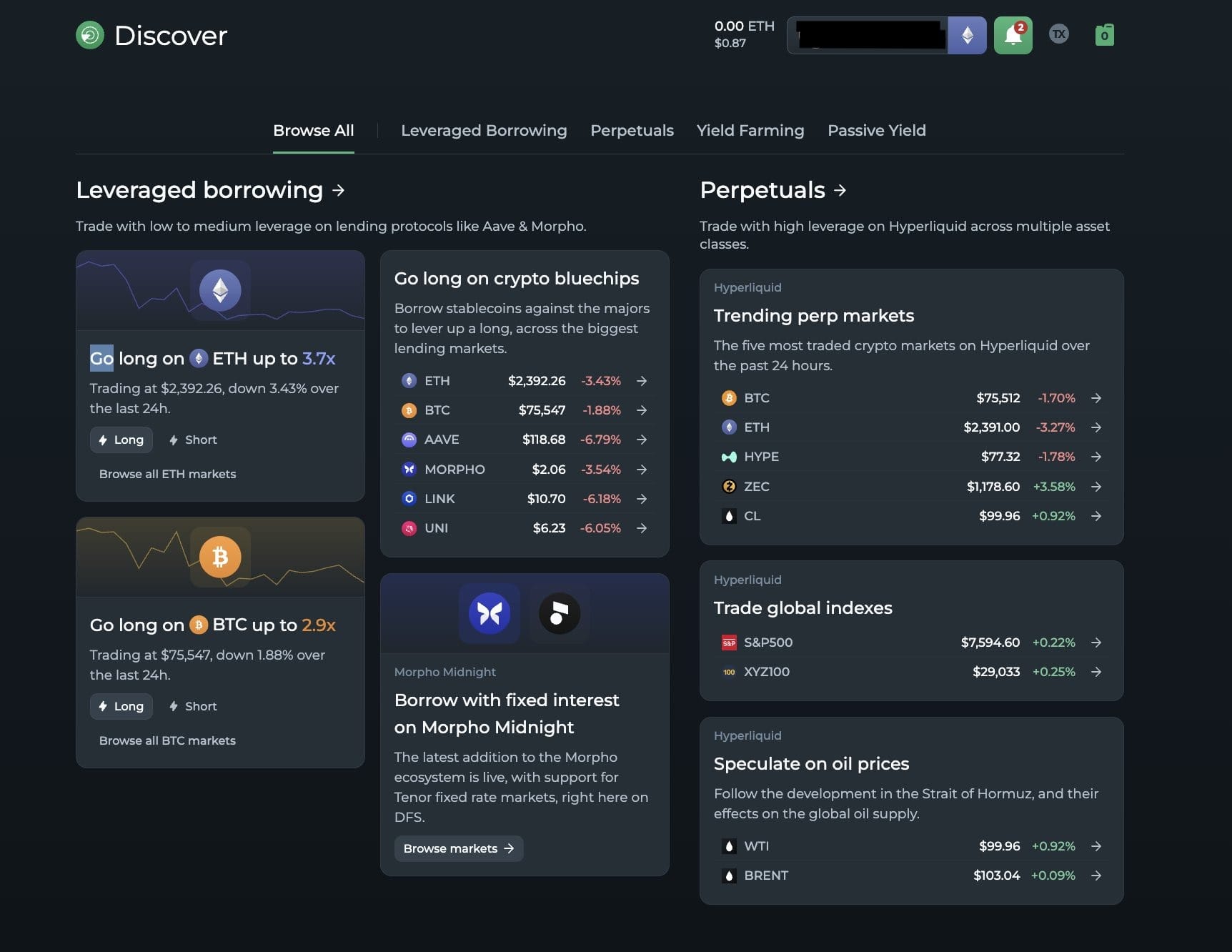
Previously, Discover was primarily about exploring everything available, with the option to filter markets by assets, protocols or chains. And Trending, on the other hand, was more about easily finding some recent or highly popular, evergreen strategies.
The new Discover page brings those two together and makes it easier to go from researching a market to actually opening a position.
Make sure to check it out at https://app.defisaver.com/discover/ and, as always, we'd love to hear your feedback on it.
Morpho Midnight comes to Mainnet
Morpho Midnight is now live on Mainnet, with DFS support covering both Morpho and Tenor markets.
The integration originally launched on Base, and Mainnet now gets the same one-transaction leverage and unwind functionalities, including Boosting or Repaying through the order book.
.@Morpho Midnight is now live on @ethereum via DeFi Saver!
— DeFi Saver (@DeFiSaver) September 14, 2026
Mainnet users now have access to Midnight's fixed-rate/term lending - and DeFi Saver's one-transaction leveraging and unwinding tools (with collateral/via orderbook).
Available for @morpho and @TenorFinance markets. https://t.co/nsZVSGJAno
For anyone unfamiliar with Midnight, the main difference from traditional variable-rate lending is that these are fixed-rate, fixed-term markets - you know the borrowing cost or return for the duration of the position instead of having to deal with a rate that changes underneath you.
Our favourite DeFi educator has a great video on Midnight, so if you want to join Milos and his famous whiteboard head on over to this Youtube video.
Keeping Hyperliquid leverage constant
We've also added something new for those managing perpetual positions on Hyperliquid.
Our new constant leverage feature lets you set a target leverage for an isolated-margin position, with DFS Automation automatically rebalancing it as the market moves to make sure your leverage level remains constant.
Your perp position can say “5×” while your actual leverage is no longer 5×.
— DeFi Saver (@DeFiSaver) September 11, 2026
As price moves, your profit or loss changes your margin, and your effective leverage drifts.
Constant Leverage brings it back to original target.
Live on DeFi Saver: https://t.co/wUwpnJj5oY pic.twitter.com/YgBzxTUjlv
As markets move, your effective leverage changes along with it. Keeping it at your desired level would usually mean monitoring the position and manually resizing it whenever necessary.
We have had a similar concept available for lending positions for quite some time through Automated Leverage Management, and Constant leverage brings that same idea to Hyperliquid perps.
Two more swap sources for better routing
We've also added De¹ and Fly to our swaps meta-aggregation engine.
They now sit alongside 0x, 1inch, Bebop, KyberSwap and Velora as one of the sources DeFi Saver checks when looking for swap routes.
TSI and slippage are onchain trader's worst enemies.
— DeFi Saver (@DeFiSaver) September 24, 2026
That's why we meta-aggregate sources at DFS to ensure you always get *the* best available rate.
Today we add another integration to ensure this promise is true: @De1_ai
De¹ builds at the intersection of DeFi and AI, aiming… pic.twitter.com/ZG11HEGLPg
This may sound like a relatively small change, but token swaps are involved in the largest part of what you can do using DFS.
Boost & Repay, Collateral & Debt Switches and Loan Shifter transactions can all involve swaps, meaning that the quality of the route can have a meaningful impact on the final result, particularly for larger amounts.
Ensuring the best outcomes in these transactions has always been a priority for us and we have more improvements in the works to move the standard even further forward.
Notify gets a couple of new tricks
For Telegram users, we've now added a Track mode to the Telegram Mini App.
You can now use it to follow any address and add monitors to individual positions directly from your phone. Try messaging @DeFiSaverBot to get started.
We've also made some improvements to the notifications you receive when an Automation is executed.
They now include more details about what actually happened to your position, so you can get a clearer picture without having to go digging through the transaction yourself.
Aave V4 Paxos market now live on DFS
Aave V4 continues to expand, and the latest market to make its way to DeFi Saver is the Paxos spoke on the Global Dollar Hub.
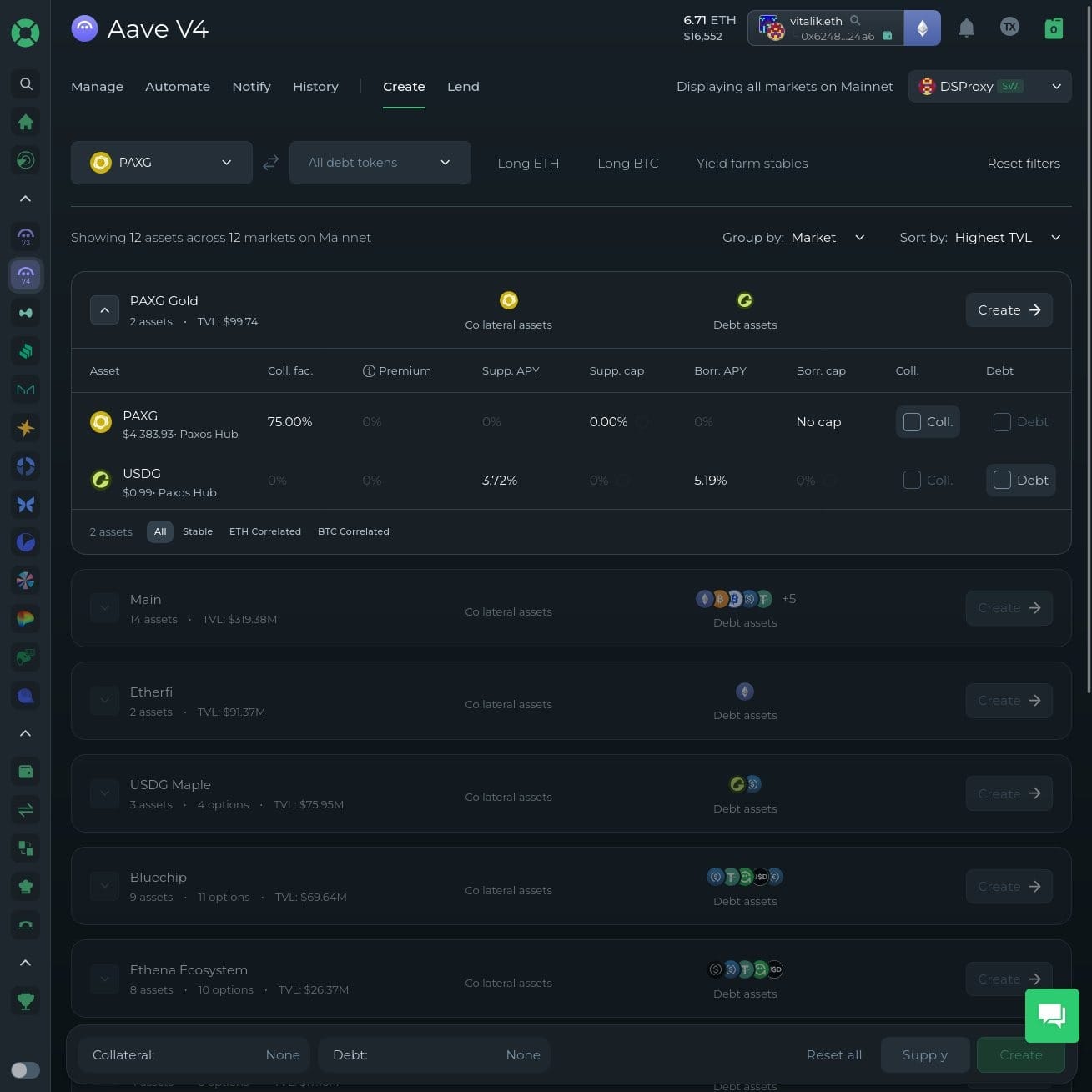
The new market allows you to supply PAXG and borrow USDG against it, as well as open a leveraged long on gold in a single transaction.
Some under the hood improvements
Not every update makes for a shiny new feature, of course. We regularly deploy smaller fixes or improvements that would be unnoticed by many (or even most), so we wanted to try highlighting a few just to give you a better idea of the kind of things we focus on.
A fix for those seemingly stuck transactions on DFS
In recent times, many wallets started using private RPCs for tx submission by default. And while this should be a good change for the users (no MEV), there is a tricky thing that's been messing with our transaction tracker until now.
You see, by default, these private RPC options will simulate a transaction and simply dismiss it if they recognise it's likely to revert. This is another plus for the users, as it stops them from paying tx fees on reverted transactions.
But this also means that these transactions never make it to the public mempool and are never actually "seen" by any other service other than the private RPC. There's simply no trace of them, no dropped status, no reverted hash to account for.
So when that happens, our frontend was waiting for a response from the wallet that never arrives, which left these transactions appearing stuck.
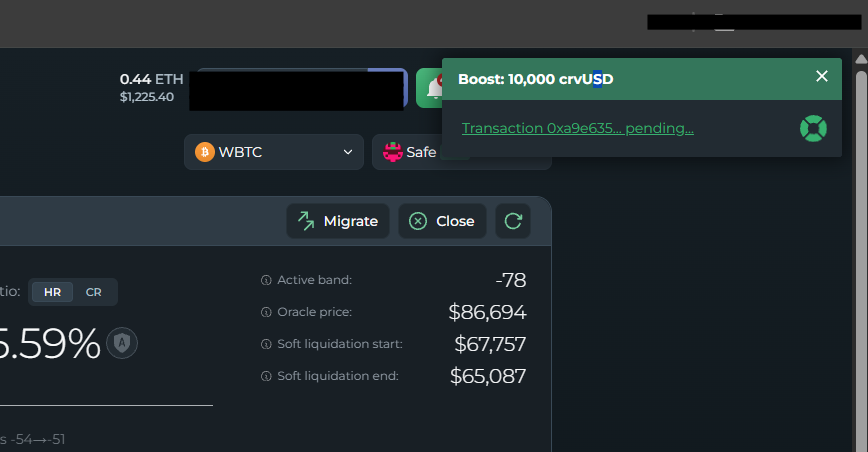
This made for a pretty confusing experience for the users, and we're actively working on a proper update to address this. But in the meantime, we've simply reduced the maximum tracking time for transactions whose hashes we can't find from multiple hours to 30 minutes to help clear your screen quicker.
So if you run into one of these again, don't worry. It should disappear after a little while, and we're working on making sure these false pending states don't happen in the first place.
Or if you're unsure whether this is exactly what's going on or something else, of course feel free to page our support team.
Limit orders get a smaller execution buffer
We've also made a small but important improvement to how Limit Orders are triggered.
We have already covered this update and topic in one of our previous blog posts, so make sure to check it out for a more detailed breakdown.
Apparently, knowing what a limit order does and knowing how a limit order actually works are two very different things.🤷♀️
— Alex 🛟 (@defi_alex23) October 2, 2026
So, back to school I went.
Give it a read. You may find there’s more to limit orders than meets the eye. https://t.co/6MvapVS8iR
To give you a tl;dr of the article, we have noticed some confusion over how these orders generally work.
On-chain limit orders need to account for the (potentially) short time window between detecting that your target price has been reached and actually preparing and submitting the transaction. Prices can move during that time, so a small buffer is needed to give the transaction enough room to execute successfully and avoid unnecessarily bad swap routes.
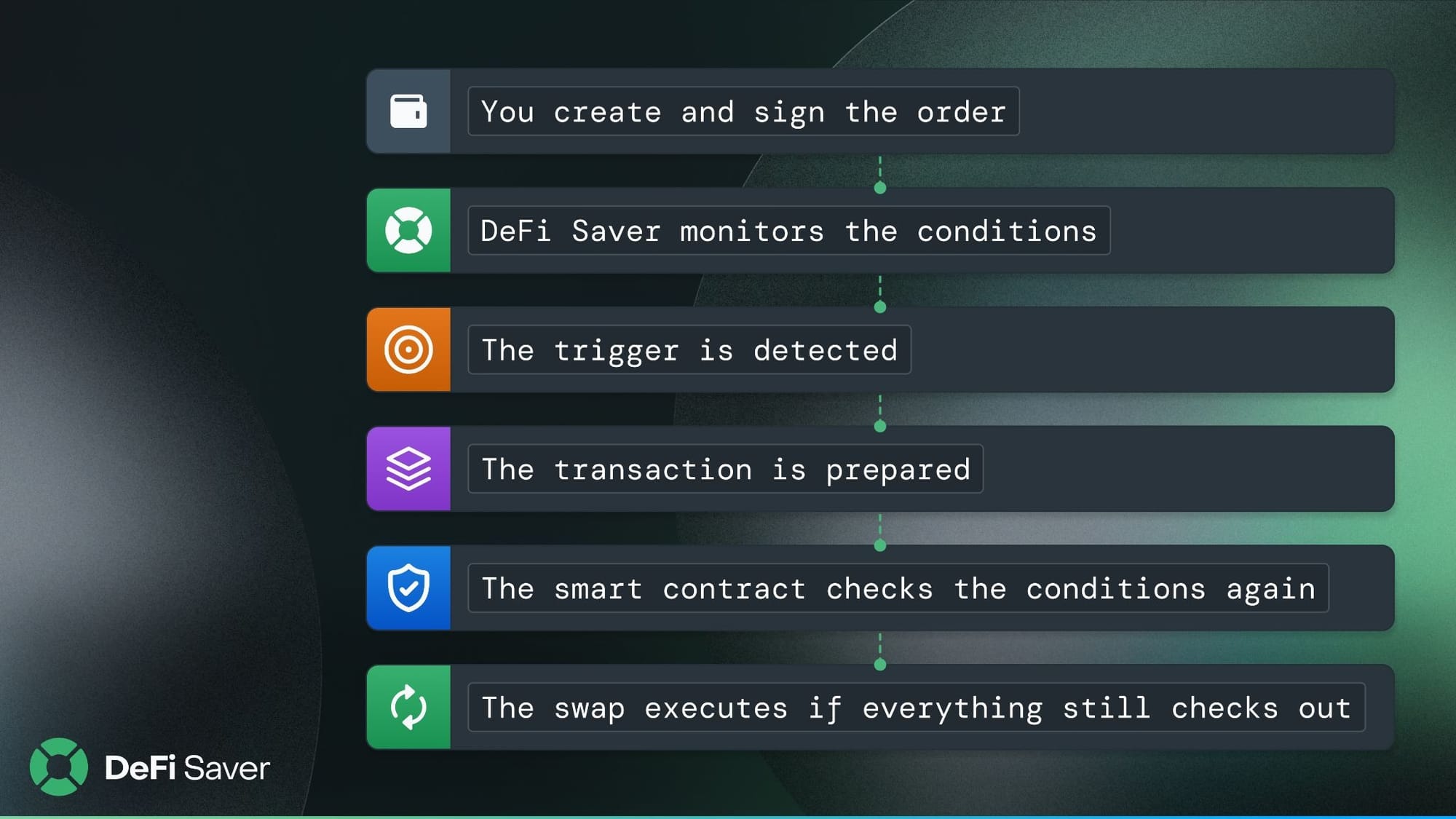
Previously, DeFi Saver used a 1% buffer for this. In practice, this meant that if you set a WETH buy order at $2,500, the available swap quote might have needed to reach around $2,475 before the transaction was triggered.
We've now reduced that buffer to 0.15% to bring the trigger threshold much closer to the price you actually set. In the same example, the quote would now need to reach around $2,496.45 before execution is attempted.
It is important to note, however, that this mechanism does not change your limit price (which effectively states the minimum accepted rate) but it means reaching that price alone does not guarantee immediate execution.
A small reminder you have to pay the piper
One of the easiest, yet somehow most difficult, questions to answer in user support is: “Why can't I submit my transaction?”
The reasons can be numerous and depend on the particular case, but one thing we've noticed coming up time and time again is that sometimes the answer is much simpler. There's simply not enough ETH in the user’s wallet to cover the gas.
We've now made it a little easier to catch this yourselves and the frontend will let you know when your wallet doesn't have enough ETH set aside for gas, so you're not stuck questioning why there's a generic error message with a blocked Accept button.
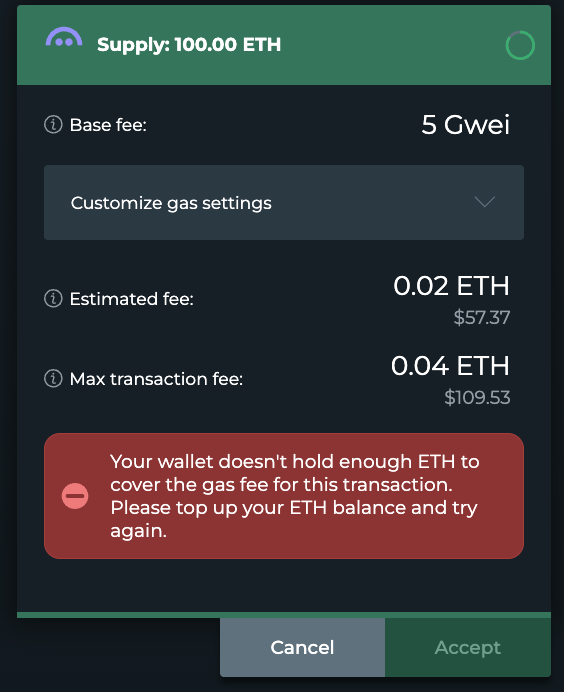
A small change, perhaps, but hopefully one that saves a few head-scratches.
September Stats
In terms of DeFi Saver metrics, September was another pretty active month. Users made more transactions than they did in August, even though overall swap volume was somewhat lower. This makes sense, especially considering that ETH price jumped by around 30% over the course of August.
Moreover, we've seen 13,982 txs throughout September, which is an increase from the 12,777 in August.
Swap volume, on the other hand, was a little quieter than in August, with $100.3M in total swap volume, compared to $122.9M the month before. Automation accounts for around $20M of that volume in September.
We ended the month with 997 automated positions managing around $461M in collateral. That's a slight increase in the total amount managed compared to August's roughly $400M, while the number of automated positions stayed around the same level, at just over 1,000.
Position highlight: let's talk Position Flip
On September 15, ETH sharply dropped from around $2,560 to $2,420. One Aave user took that as a signal to flip their position from long to short, potentially looking to position for more downside as the market started turning weaker.
The next day, ETH kept falling, reaching around $2,388. The user flipped again, this time back to a long position.
So, in the space of about a day, they went from being positioned for ETH to fall to being positioned for it to recover.
But what does that actually look like on-chain?
Position Flip bundles the steps needed to switch between the two sides of an Aave position into a single transaction.
The basic flow looks like this:
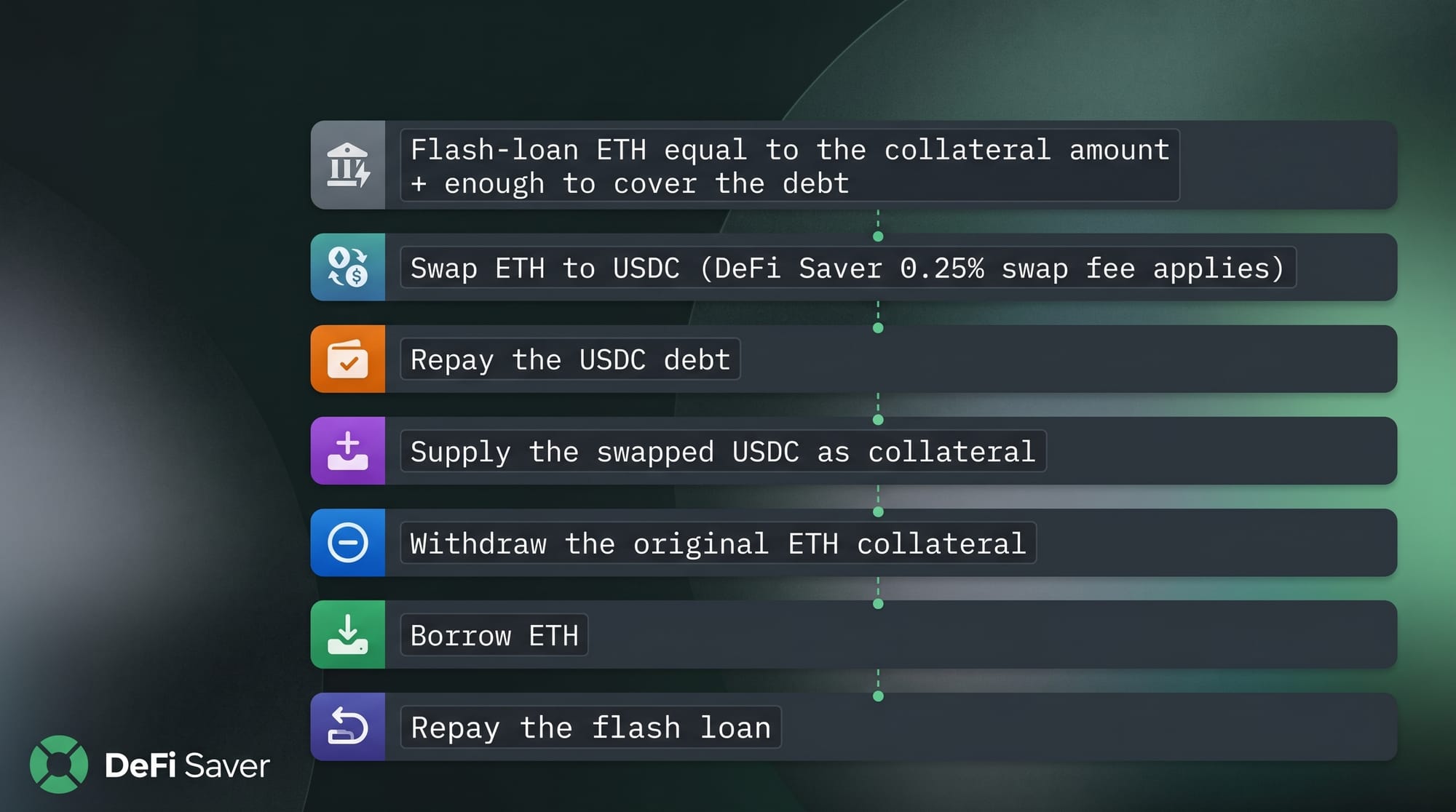
The flash loan provides the temporary liquidity needed to restructure the position. DeFi Saver swaps the flash-loaned ETH for USDC, pays back the old debt, supplies the new collateral and borrows the new debt asset.
Any potential excess left over is returned to the user, while the flash loan is repaid at the end of the transaction.
In this particular case, the transaction used a 52.36 WETH flash loan from Morpho. DeFi Saver first looks for the cheapest available flash-loan liquidity source. If that source isn't supported for the transaction, it automatically moves on to the next most cost-effective option. The 0.25% DeFi Saver fee for this transaction was $337.
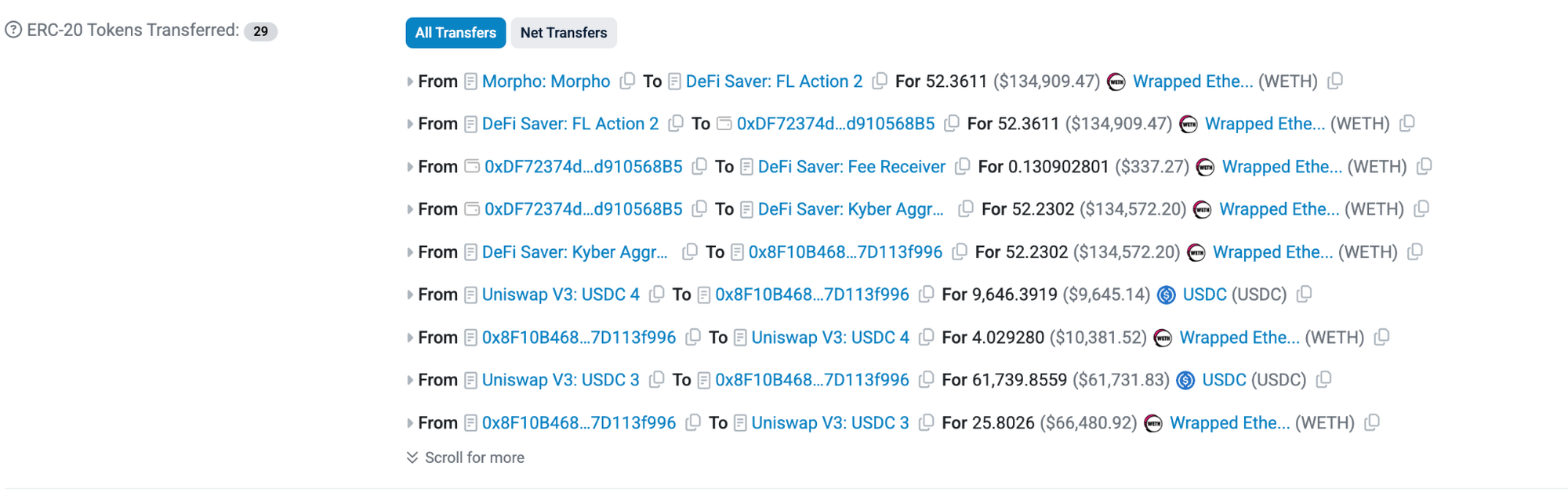
The WETH was then routed through the Kyber Aggregator, which split the swap across multiple Uniswap V3 pools and returned 124,953 USDC. That USDC was then split between the two sides of the new position: 46,002 USDC was used to repay the existing Aave debt, while the remaining 78,951 USDC was supplied back into Aave as collateral.
To be fair, this is also possible with the existing Collateral Switch and Debt Switch tools, but Position Flip essentially puts the whole process together and takes one extra step out of the equation.
That would be all for this edition of the DFS Newsletter. As always, if you have any feedback, questions, or just want to share what you'd like to see us work on next, come say hi in the DeFi Saver Discord. We always appreciate hearing from the community.
See you again next month!
Stay connected:
📢: Official Twitter/X