DeFi Saver Newsletter: August 2026
This month, we cover the latest EIP discussion making waves across the DeFi community, our newly launched lost token finder, the Aave v3 to v4 migration tool, and much more.
What a month. We’re back again to walk you through everything that made July an interesting one for our team and the wider DeFi community.
We’ll cover the upcoming Glamsterdam upgrade, the latest Ethereum EIP sparking discussion across crypto socials, as well as the latest (and particularly interesting) DFS launches and feature upgrades. Here’s what we’ve got for you this month.
- Ecosystem news: Just everything EIP
- DFS news and updates: Aave v3 to v4 migration tool is live, the launch of our Liquidation Protection and lost token finder, and portfolio monitoring now possible in the DFS Telegram mini-app;
- DeFi Saver Stats for July.
- Position of the month.
Let’s talk EIPs
In the continuous effort to increase Ethereum's scalability, the upcoming Glamsterdam upgrade is set to introduce EIP 7732 and EIP 7928 - two proposals aimed at improving the network’s ability to process data and txs more efficiently.
EIP 7732 (Enshrined Proposer-Builder Separation) will extend the time needed to build blocks and move the process "directly into the protocol, replacing third-party relays".
EIP 7928, meanwhile, introduces BALs (Block Level Access Lists) to pinpoint tx requirements before the block processes them. This then allows Ethereum to perform more tasks in parallel rather than processing everything sequentially. For example, it can read data from disk, validate transactions, and calculate state updates at the same time.
Glamsterdam is officially in its final testing phase and set to go live soon, sometime in the midst of Q3.
Ethereum’s next major upgrade, Glamsterdam, is moving into its final testing phase and is expected on mainnet in the second half of 2026 (most likely around September–October).
— Ethereum Daily (@ETH_Daily) July 29, 2026
Here’s what it actually does for the network:
- It introduces enshrined Proposer-Builder Separation… pic.twitter.com/CMs8EJeKB6
And while we’re on the topic of EIPs, there is another one sparking quite a lively debate on X, and for good reason.
Unfortunately this proposal doesn't achieve the outcome it tries to achieve and is actually hurtful for Ethereum.
— Stani (@StaniKulechov) August 4, 2026
It caps Ethereum staking rewards to 0% when over 50% of supply staked.
What this mean is that Ethereum staking yield becomes unpredictable and even fully… https://t.co/IYUst52Dt3
The drafted EIP-8363 (aka “Tapered Issuance Burn”) proposes changing Ethereum’s staking reward mechanism by gradually reducing staking incentives as the amount of staked ETH increases.
Today, as more ETH is staked, the yield paid to each validator gradually decreases, but new ETH issuance should never fall to zero. Critics argue that this leads to non-stakers being exposed to inflation, while stakers are being incentivized to continue locking up ETH.
And what’s most relevant for our users, the proposal could also have a significant impact on LST loopers, users who deposit assets such as wstETH, weETH, or rETH as collateral, borrow ETH, and loop the position to amplify staking yield. This strategy relies on staking yield remaining higher than the cost of borrowing ETH.
As a result, EIP-8363 could reduce demand for LST-backed borrowing across Ethereum’s lending markets and potentially reshape one of DeFi’s most established strategies.
It is worth noting, however, that EIP-8363 is still merely a product of discussion. It will most definitely not be adopted now as part of Glamsterdam, and there is no certainty that it will be adopted for the subsequent upgrade (Hegota).
DeFi Saver news & updates
The past month has been especially exciting for our team, as we’ve taken a new approach to tackling some more specific use cases.
And if you’ve been in the DeFi space for some time (especially if you’ve used DSProxies), there’s a good chance you’ll find this chapter particularly useful.
DeFi Saver launches lost token finder
We launched Token Saver, a new tool that helps you find forgotten or unclaimed crypto assets sitting in old smart wallets.
Over the years, you have probably interacted with different types of smart wallets across lending protocols and other DeFi projects. Some of these wallets are no longer in use, but can still hold leftover token balances.
After a little digging, we found more than $50 million worth of recoverable assets, ranging from unclaimed airdrops to tokens left behind after closing or unwinding DeFi positions.
There's $67M+ in unclaimed tokens sitting in 87K smart wallets all across DeFi.
— DeFi Saver (@DeFiSaver) August 5, 2026
We're talking blue chip assets, including:$ETH - $3.4M$USDT - $6.9M$sUSDS - $10M$WBTC - $6M
So we built a tool that lets you claim the tokens you forgot you had: https://t.co/W897AaG6mx pic.twitter.com/BJwxmKRx7b
Token Saver makes it easy to check whether any of those assets belong to you. Simply enter your wallet address or ENS, and the tool scans associated smart wallets to show any recoverable tokens, their amounts, chains, and current value.
If you find something, simply hit Recover to move the assets back to your wallet through DeFi Saver.
It’s worth checking. Even if you haven’t used DeFi in a while, you might find a few bucks hiding in those old pockets.
For more on what prompted us to create Token Saver and how we uncovered these forgotten assets, check out our previous blog post.
DeFi Saver launched Liquidation Protection
We’re introducing a new, minimal automation option designed to protect users from liquidation. And yes, liquidation protection has always been part of the DFS toolkit in the form of Auto-Repay.
However, we’re making things simpler and far more intuitive.
What if you just don't get liquidated?
— DeFi Saver (@DeFiSaver) August 10, 2026
Today we are introducing Liquidation Protection.
A minimal automation option that we believe every lending protocol user should enable to avoid liquidation penalties at all times.
Available now across all of the top DeFi protocols. pic.twitter.com/KzYxSLUaAL
Liquidation protection monitors your position 24/7. The moment the health of your position drops to critical levels, it will use the minimum amount of collateral needed to repay a part of your debt.
Available now for Aave, Morpho, Compound, Fluid, Spark and Maker, across Mainnet, Arbitrum, Optimism, and Base.
The first-ever Aave v3 to v4 migration tool is now live at DFS
We also made it much easier to move your Aave V3 position to V4.
With DeFi Saver’s new migration tool, you can now migrate an entire position in a single transaction, without manually unwinding your V3 position and rebuilding it on V4.
First Aave V3 to V4 migrator is live, powered by @DeFiSaver. Moving positions between Aave V3 and V4 becomes seamless. https://t.co/Wy3bKD9Euu
— Stani (@StaniKulechov) August 4, 2026
To be fair, users could already migrate from Aave V3 to V4 using DeFi Saver’s Loan Shifter. The new migration tool simply makes the process much more accessible. Now, users can migrate directly from their Aave V3 dashboard with just a few clicks.
Notify now lets you monitor your portfolio on the go
Notify lets you set up and edit alerts for safety ratios, supply and borrow caps, and automation triggers, all directly through Telegram.
You’ll receive an alert whenever one of your chosen thresholds is reached, so you can stay on top of your positions without needing to open the app itself.
Want to monitor your portfolio no matter where you are?
— DeFi Saver (@DeFiSaver) August 7, 2026
Now you can. 🛟
You can easily check on your positions through Telegram and set alerts that'll keep you informed whenever the configured thresholds are met.
Whether it's monitoring your Safety Ratio, tracking supply and… pic.twitter.com/it8ioDkfnP
And now, you can even view your entire portfolio directly from your phone, be it on Mainnet, Arbitrum, Optimism, or Base.
DeFi Saver stats
From the beginning of July until now, we’ve seen $ETH climb from around $1,569 to nearly the $2,000 mark toward the end of the month.
During this period, DeFi Saver made around 10,757 tx. Out of those, 3,358 involved swaps and account for approximately $116M in total volume. Around $3.9M of that amount accounts for Aave V3 users, while another $1.7M came from Aave V4.
Meanwhile, DeFi Saver Automation currently manages approximately $263M in collateralized assets across 873 user positions.
Position of the month
For this month’s position analysis, we’ll be brushing up on some basics and taking a look at a seemingly simple, yet potentially risky position on the Ethena Ecosystem market within Aave v4.
On July 7, 2026, a user opened a 9.5x leverage position by depositing approximately 12.425 sUSDe ($15,470) as collateral and borrowing USDT.
Since opening the position, the user has not made any adjustments or taken any further actions. This raises an interesting question: why would they be comfortable leaving their position with a safety ratio of just 103.09% (health ratio of 1.03), a level that would typically be considered extremely risky?
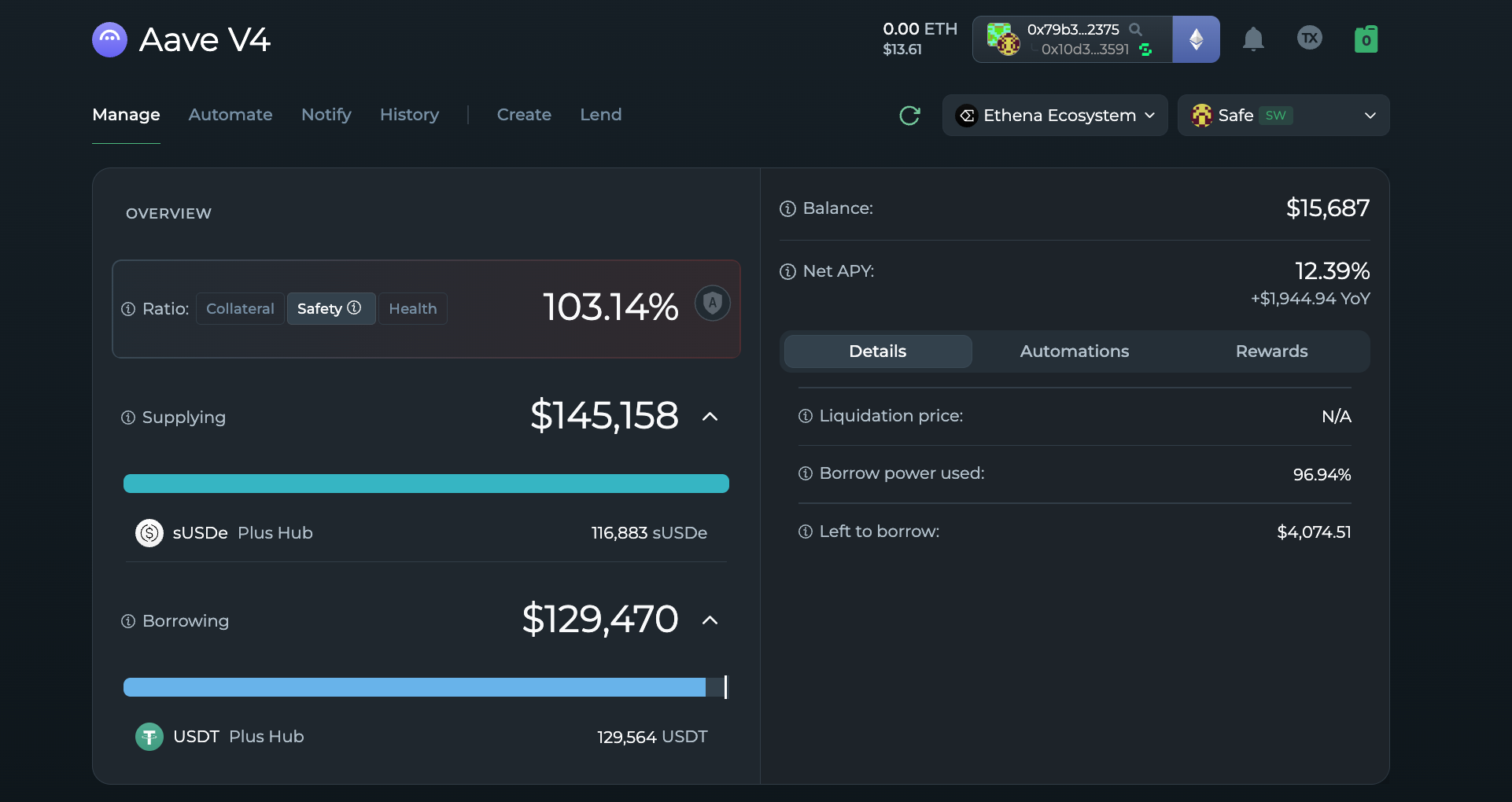
Both sUSDe and USDT are stablecoins, so there is seemingly little opportunity to profit from price appreciation while maintaining such a thin liquidation buffer.
Alas, the key distinction is, of course, that sUSDe is not simply a dollar-pegged stablecoin - it is a yield-bearing asset.

Because USDT maintains a very tight 1:1 peg with the U.S. dollar, while sUSDe steadily appreciates through accrued yield, the user's collateral naturally grows over time relative to the borrowed asset. As a result, even though the initial health ratio appears dangerously low, the position is safe either way because of the oracles used- provided USDT maintains its peg and Ethena's yield mechanism continues to function as expected.
This explains why the user may have been comfortable leaving the position untouched despite what initially appears to be an unusually high liquidation risk.
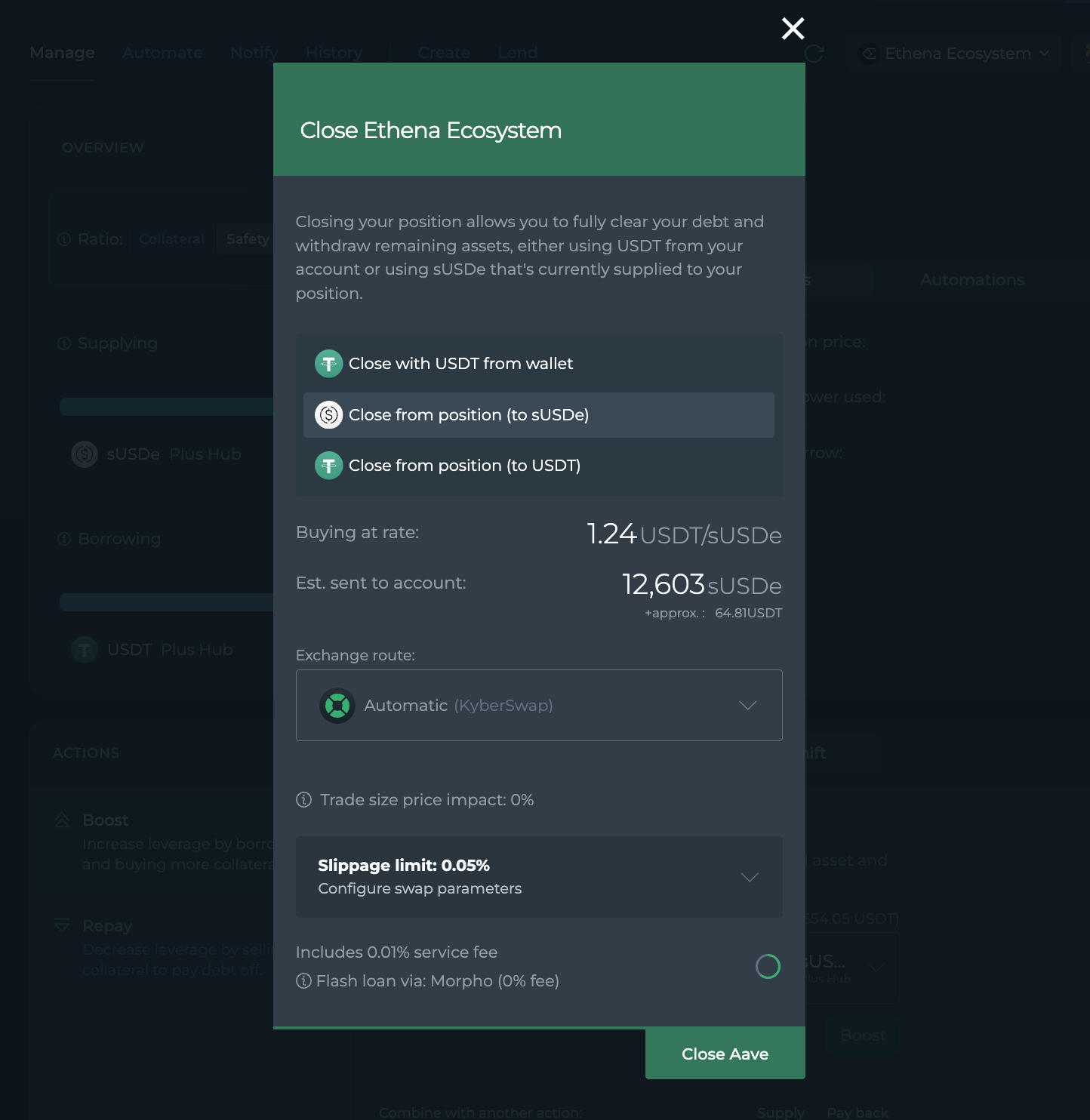
If they were to close today, they would walk out with approximately 12.603 sUSDe (a profit of 178 sUSDe/$220). The user should, however, keep an eye on that USDT borrow rate. When the position was opened, the borrow rate was around 2.29%, while it sits at 3% now.
This is where DFS Discover can come in handy. They can monitor rates across all the markets and protocols we support. And if they find that another protocol is offering better rates, they can simply use Loan Shifter to move their position entirely.
We do hope you found this edition of the DFS Newsletter informative, and if there are any other topics that you would like us to cover in the future, be sure to let us know via DFS Discord.
Until the next post, stay safe out there!
Stay connected:
📢: Official Twitter/X