DeFi Saver Newsletter: November 2026
In this issue: the Binance hack and its ripple effects on DeFi lending, the recent market crash and how DeFi Saver’s tools rose to the occasion, plus a roundup of everything new in the app.
It’s been quite a month for DeFi, to put it mildly.
October and early November brought one of the largest exploits in DeFi history, a wave of precautionary measures across lending protocols, and a sharp market downturn to top it all off.
Through the chaos, DeFi Saver’s tools helped users adapt to fast-changing conditions and manage their positions when it mattered most.
Now, let’s take a closer look at what’s been happening.
The Binance hack and how it affected DeFi
On October 29th, two Binance hot wallets were drained in an incident involving an estimated $6.3B in stolen funds.
The funds were quickly moved across multiple networks, thus prompting Binance and its partners to freeze around $3B and several DeFi protocols to introduce precautionary measures to limit potential exposure.
One of those precautionary measures came from Aave, which initially froze all of its v3 and v4 markets. Compound soon followed suit.
However, within roughly 24 hours, both protocols began reopening their markets, with some restrictions remaining in place. On Aave V3 and V4, for example, USDC and USDT were assigned an LTV of 0 (which still stands as of this newsletter going live).
Update following the Binance incident:
— Aave (@aave) October 30, 2026
All markets are now unfrozen across Aave V3 and V4.
They were frozen as a precaution after initial reports, which paused new deposits and borrows while withdrawals and repayments continued as normal.
Aave contracts were unaffected by the…
This means that users can no longer use these assets as collateral to open new debt positions or add them as collateral to existing ones. As a result, some existing positions had fewer options for managing their collateral and debt, leaving them more exposed to market movements and potential liquidation.
And how does this currently affect DeFi Saver users?
For Aave v3, users can still access tools such as Repay, Withdraw, Payback, and Close, as well as Repay automation.
For Aave v4, however, positions backed exclusively by USDC or USDT cannot use Borrow, Boost, or partial Repay using collateral. Boost and Repay automations are affected as well. Users can still Supply assets and pay back debt using funds from their wallet. Fully repaying the debt before withdrawing collateral also bypasses this restriction.
tl;dr - Aave froze (V3 and V4) markets across mainnet and Base
— nikola_j (🛟,🛟) (@_nikolajankovic) October 29, 2026
💡Important reminder for DFS Automation users:
Updates done earlier this year mean automated-repays and liquidation protection options still work with these LTV0 parameters in place. https://t.co/NnuWtsN5MS
For positions with mixed collateral, these actions remain available as long as other eligible collateral sufficiently covers the remaining debt after the action.
DeFi Saver introduces Loan Shifter V2
Since its launch in 2020, Loan Shifter has helped users move collateral, debt, or entire positions between protocols in a single tx, without having to close everything and rebuild it from scratch..
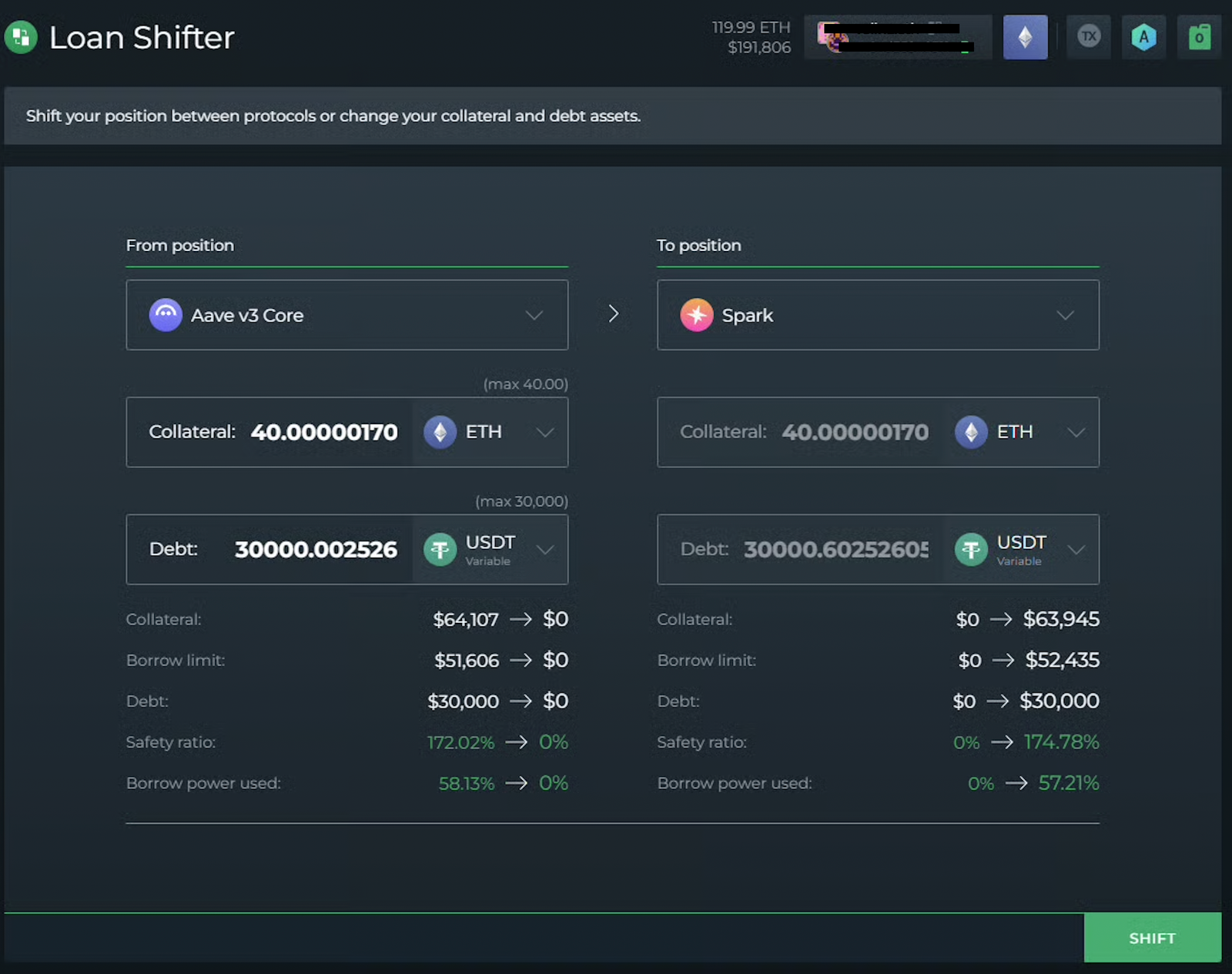
Now, you'll find a refreshed interface, faster loading, and a much clearer overview of your position before making the move.
This includes collateral and debt amounts and asset types, Net APY, liquidation price, and safety ratio, so you can see exactly what you're working with.
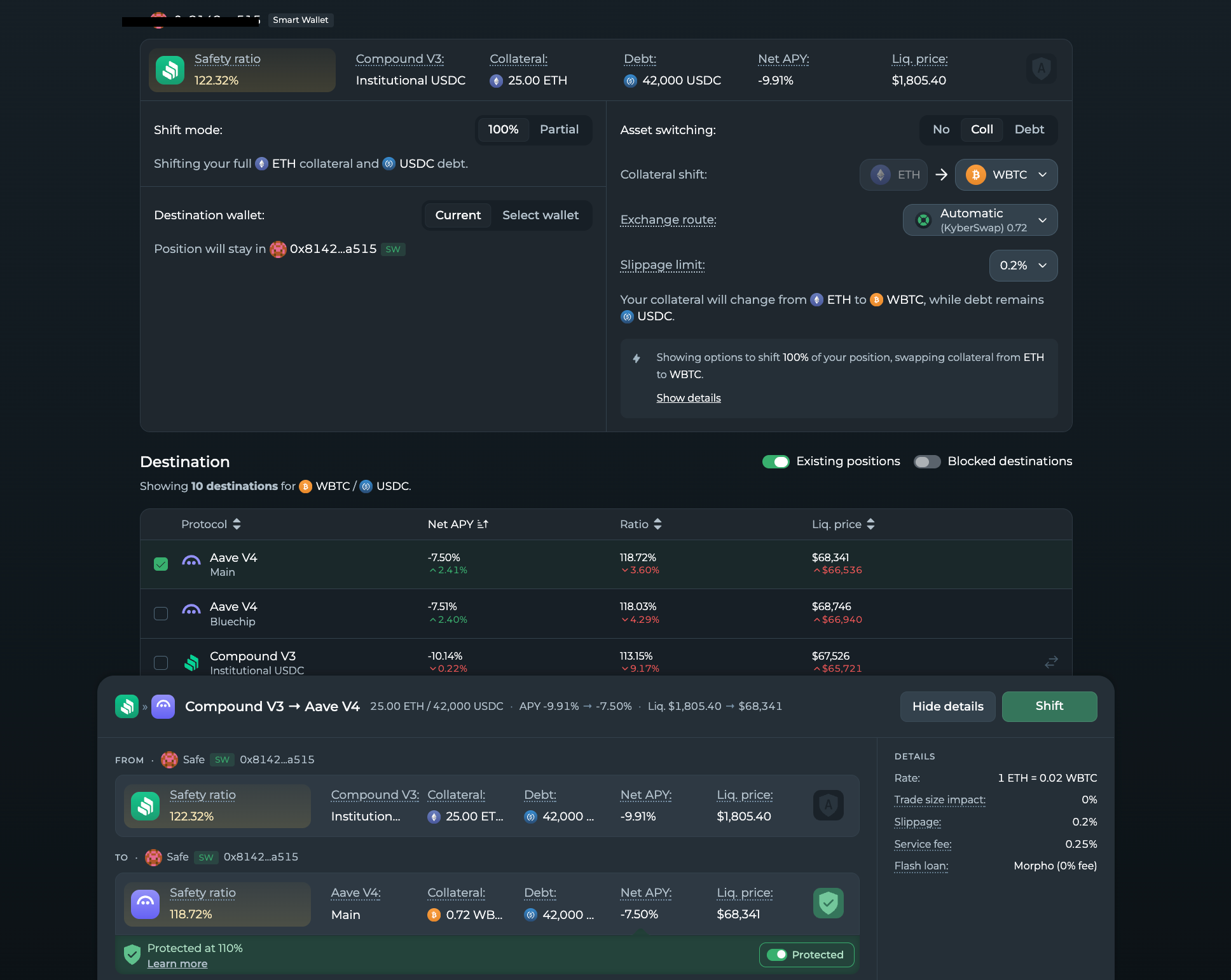
But it's not all looks.
Loan Shifter now supports EOA positions, meaning you no longer need a smart wallet to shift your position. Partial shifts are also here, allowing you to move just a portion of your collateral, debt, or entire position instead of committing to the full move.
And if you like having a bit more say in how things are done, you can now choose your swap routes, adjust slippage, and select your preferred target market.
We’ve covered this in a bit more detail in one of our previous blog posts, so if you’d like to take a closer look at what’s changed, you can find the full breakdown here.
Some new markets for your convenience
Sometimes we choose integrations based on what we think might be useful. Other times, you simply reach out and ask, and we make it happen.
And such was the case this time, when a couple of users asked for an integration of Morpho markets with EURCV and EURC as debt assets:
We've also added a cbHYPE market on Morpho on Base.
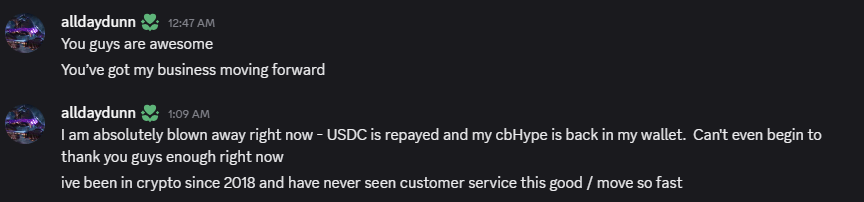
It's always great to see this kind of feedback from the community. Our dev team moves fast, but a big shoutout also goes to our support wizards, who help bring your requests and feedback to the right people and are always around to help with questions and the occasional hiccup.
So, if there's a market you'd like to see integrated or a feature you think we're missing, drop us a message on DFS Discord.
$BOLD campaign rewards distributed to eligible users
As part of another Liquity V2 × DeFi Saver campaign, 8,000 BOLD in rewards have been distributed to eligible participants.
ICYMI, the campaign kicked off back in August. To qualify, users could either open a leveraged Liquity V2 position through DFS or move an existing loan over to Liquity V2 using Loan Shifter.
To be eligible, positions needed at least 10k in debt, and the trove had to stay open for 30 days. Furthermore, the 8,000 BOLD reward pool has then been split pro rata based on each participant's debt.
The snapshot was taken, and rewards were sent out in late October, so if you took part, your BOLD should already be in your wallet.
Another @LiquityProtocol V2 x DFS campaign has officially wrapped and rewards have been distributed to their rightful owners. 🤝
— DeFi Saver (@DeFiSaver) October 29, 2026
Congrats and thanks to everyone who took part.
You can find the full list of eligible wallets in the original post below. https://t.co/CZO7m9DCPr
Big thanks to everyone who joined in and to the Liquity team for another great collab!
DeFi Saver Monthly Stats
Before we get to the October numbers, here's a quick look at a rather busy weekend.
On the night of November 8, the sharp ETH and BTC wick led to the liquidation of around $700M in leveraged longs across the market.
Across Aave, Compound, and other protocols, DFS users put roughly $31M in collateral to work repaying debt, with around $5M of that handled through our automation tools.
One particularly notable move came from an Aave V3 position that used 2,333 wstETH to repay $6.4M in USDC debt in a single Repay tx.
For the full breakdown, including which assets saw the most activity, check out our recent thread on X:
While ~$700M in leveraged longs got wiped in tonight’s $ETH / $BTC wick, DeFi Saver users were reducing liquidation risk.
— DeFi Saver (@DeFiSaver) November 8, 2026
$31M in collateral used to repay debt across @aave, @Compound_xyz, and other protocols - including $5M through our automations tools.
Here’s how our Repay… pic.twitter.com/MTcyTPI7NK
Now for the usual stats.
We recorded 13,497 txs in October, slightly down from 13,982 in September. Swap volume, on the other hand, jumped to $177.5M from $100.3M the month before, with automation accounting for around $28M of it (compared to last month’s $20M). Not too surprising, given the Binance hack and the market crash that followed, where plenty of users took steps to protect their positions.
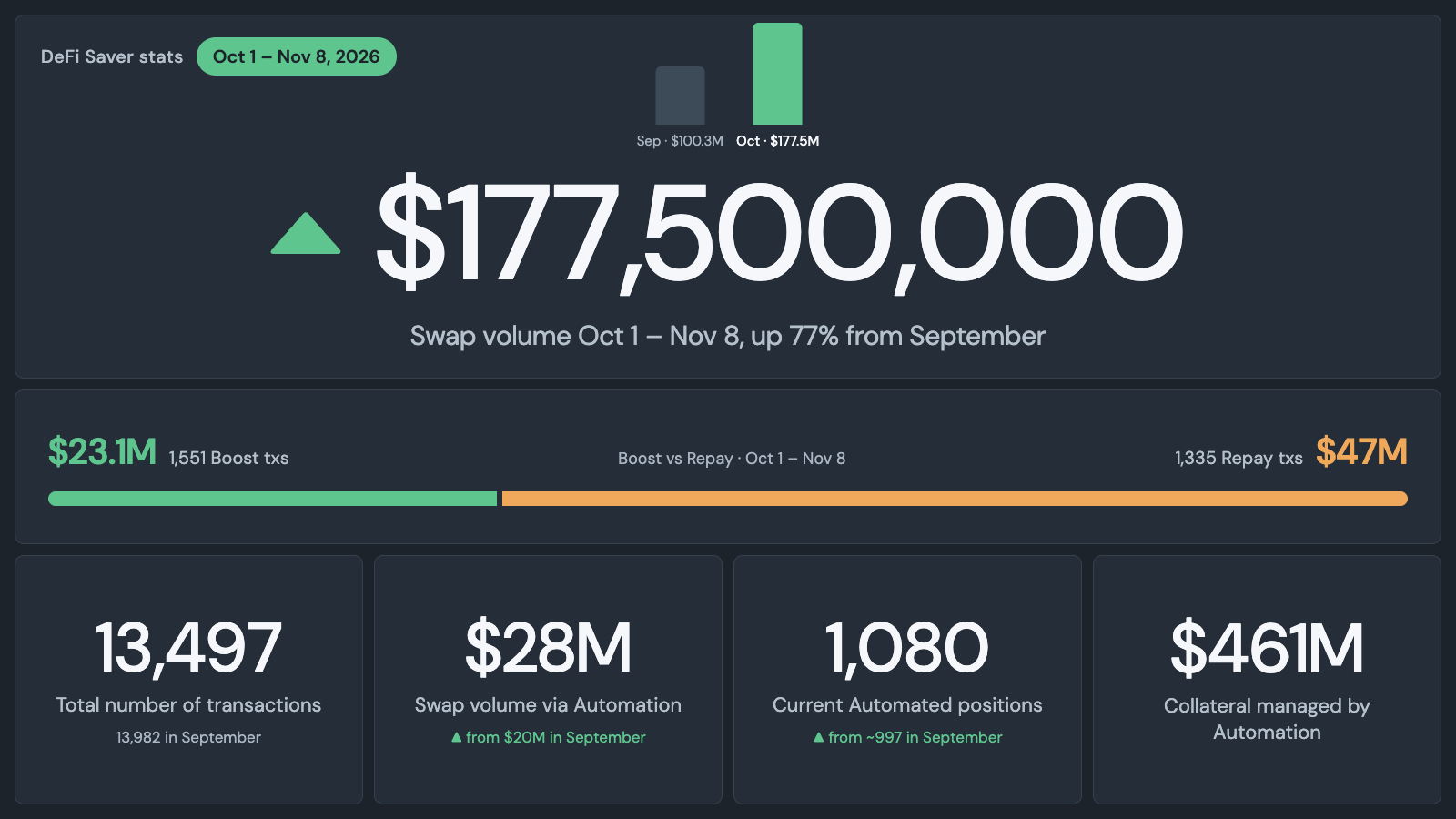
And if you’re still wondering how users have been feeling lately, the numbers speak for themselves. Since October 1st, there have been 1,551 Boost txs totaling $23.1M in volume, compared to 1,335 Repay txs totaling $47M.
We ended the month with 1,080 automated positions, up from about 997 in September, managing around $461M in collateral, roughly the same as the month before.
Position of the month: let’s talk Loan Shifter
This month's highlight goes to Loan Shifter.
And yes, we've been talking quite a bit about how useful it can be when you want to move your position to a protocol or market with better borrowing conditions, whether that's a higher LTV or a more favorable APY.
But let's take a closer look at what that looks like in practice.
On November 3rd, one DeFi Saver user moved a $13.7M position from MakerDAO to Spark in a single tx, thus shifting 11,089 wstETH in collateral and 13.73M DAI in debt.
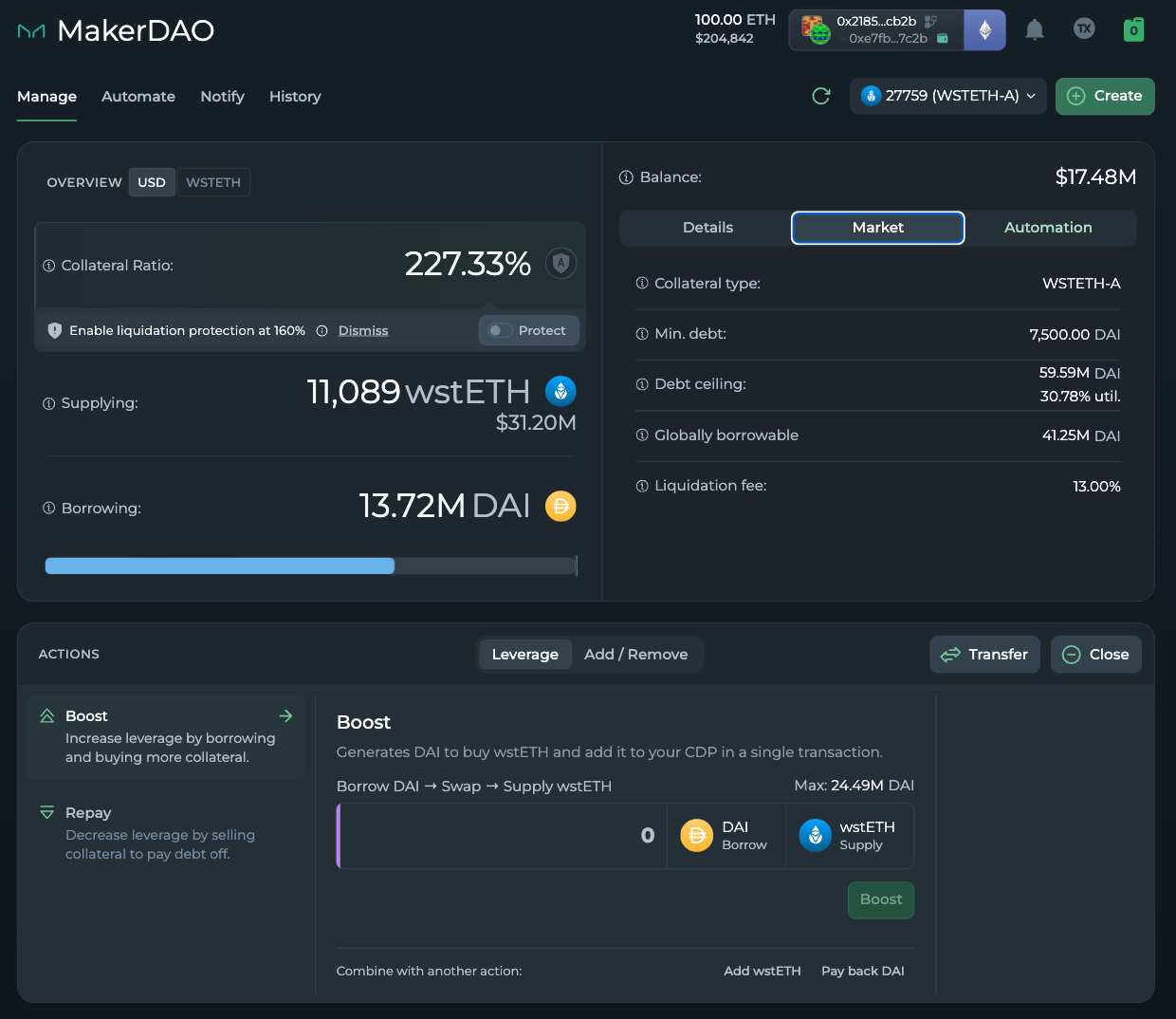
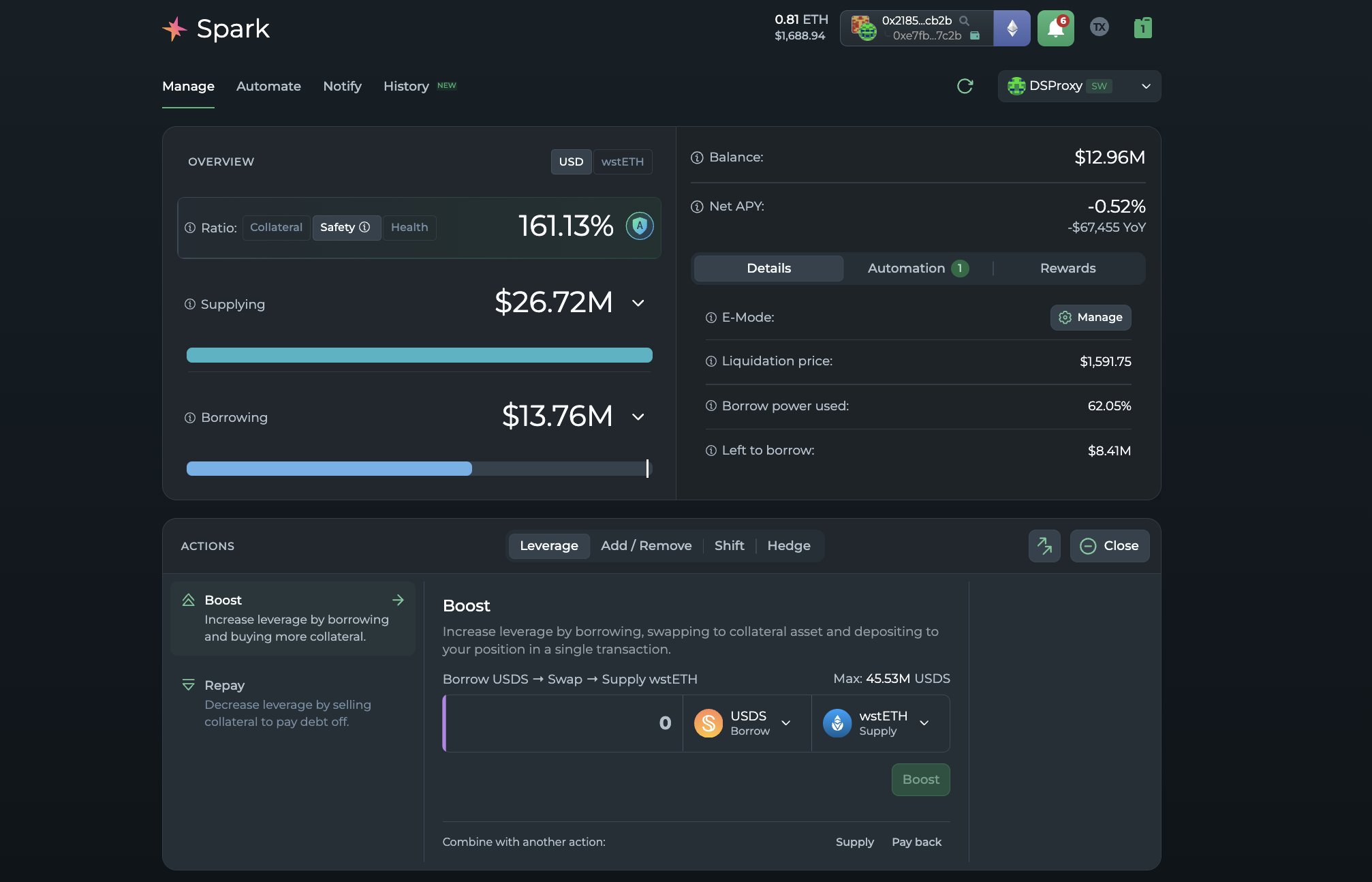
Why make the move? Simply put, Spark offers better terms. It allows a higher LTV on wstETH, meaning the exact same position now has a liquidation price of around $1,592, down from $1,857 on Maker.
Borrowing costs also took a significant turn for the better. Maker's 11.5% stability fee would amount to roughly $1.58M in annual interest. On Spark, the position now carries a borrowing rate of 5%, translating to approximately $67K in annual borrowing costs.
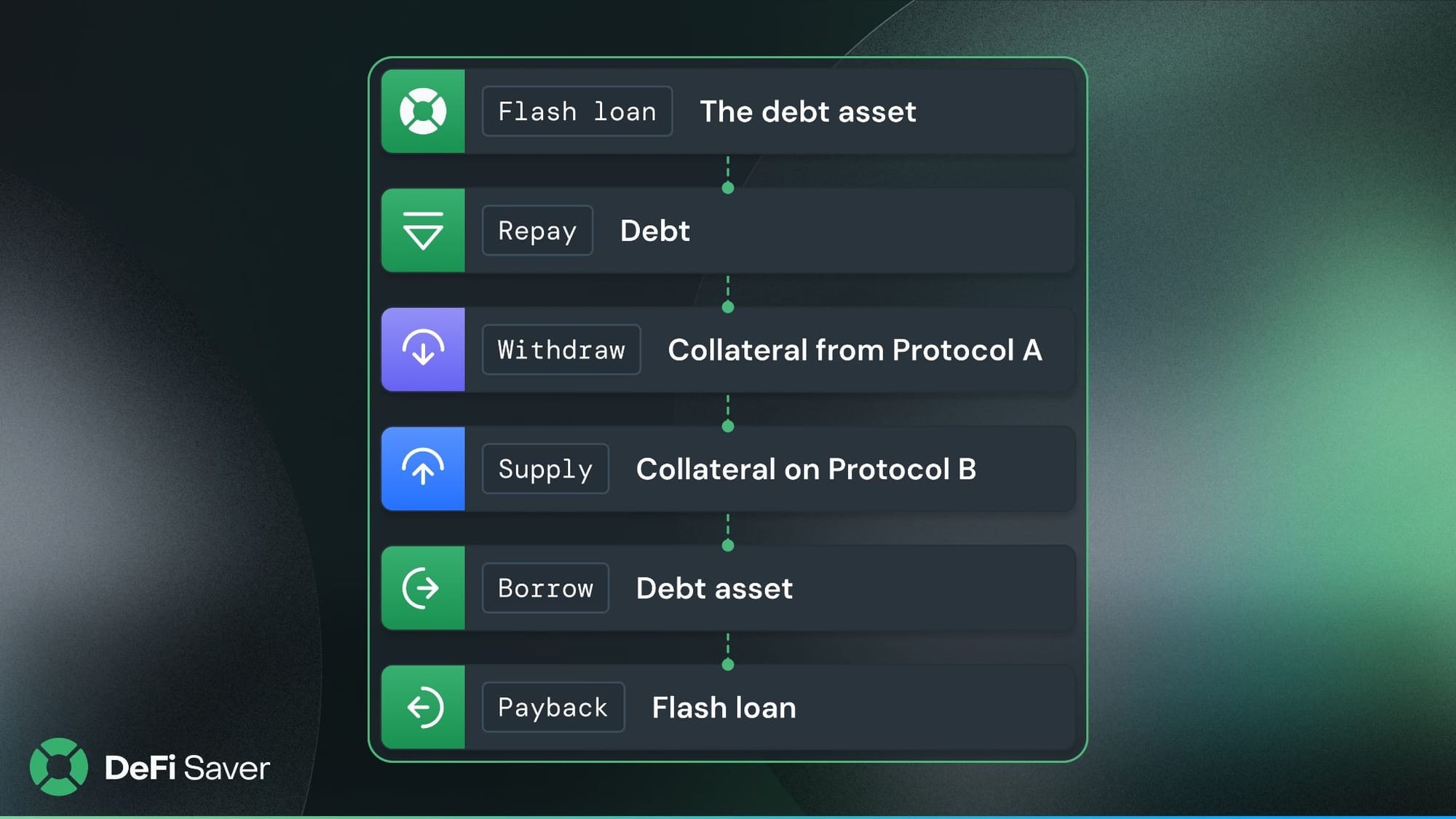
But what exactly happens within that one tx? Glad you asked.
The transaction started with Maker's own flash mint, which provided 13.73M DAI to repay the vault's outstanding debt. With the debt cleared, the 11,089 wstETH in collateral was released and supplied to Spark, where the user borrowed 13.76M USDS against it.
After deducting the 0.01% DeFi Saver fee (1,375.56 USDS), the Fly aggregator handled the swap back to DAI. Around 99% of the USDS went through Sky's native converter at a 1:1 rate, while the remainder took the scenic route via Uniswap V4 and Sky's LitePSM.
The resulting DAI was enough to repay the original flash mint, with 26,349 DAI left over and sent straight to the user's wallet.
Had he chosen not to shift, the user would have paid approximately $17,400 more in interest over the past week, or around $2,500 per day
And all of this without the user having to manually repay the old position, withdraw collateral, supply it elsewhere, and open a new debt position.
That wraps up this month's Positions of the month, as well as the November edition of the DFS Newsletter.
As always, feedback is welcome in Discord or on X, so let us know what you'd like to see more of.
Stay connected:
📢: Official Twitter/X