The Kelp DAO hack affected your position? Here are some options.
The rsETH incident has caught the DeFi community by surprise, leaving many users stuck and unable to manage their positions. But do not fret too much, because there are still some actions you can take to protect your funds, and in this post, we'll go over exactly what those options are.

On April 18th, KelpDAO's bridge smart contract was breached, ultimately losing around $292M rsETH tokens.
Since the stolen amount could not be swapped due to its size, the hacker immediately opted to reuse that rsETH as collateral across several protocols (such as Aave v3, Compound, Fluid, and Euler).
This led to Aave governance freezing the ETH and (w)rsETH markets across Core, Prime, Base, Plasma, and Linea instances. At the same time, they set the LTV to 0 for both of the assets. On ther other hand, Compound governance fully paused WETH, USDC, and wstETH "Comets" (aka V3 markets) on Ethereum mainnet, as well as WETH markets across Optimism, Base, Arbitrum and Linea.
After the exploit became public, many were quick to withdraw their assets from Aave, effectively creating the first major bank run in DeFi. And this didn't just include ETH, but also spread to stablecoins like USDC and USDT, some of which were borrowed by the ETH suppliers in order to ensure they have some kind of value preserved while the whole situation resolves.
As a result, many markets have been at 100% utilisation for days. And even after Aave unfroze ETH, its constantly been fully utilised, meaning that all of the ETH deposited in Aave is currently borrowed. As such, suppliers have nothing to withdraw at the moment - leaving them stuck.
You can check out our rundown of what happened and how it affects your position in our knowledge base, or if you'd like to better understand what even happened, consider checking out the latest video on our Pick DeFi channel.
But if you're already up to speed with everything, here are the options currently possible for your position:
- You can choose to do nothing and wait it out;
- Swap your collateral for another asset with Collateral switch;
- Move your position to another protocol with Loan Shifter;
- Repay (unwind) your ETH position (or clear ETH debt at a discount)
Let's cover all of these in more details.
Should you simply wait things out?
This can be a conscious choice for anyone to make, in the hopes that these teams and projects will fully resolve the situation allowing everyone to walk out without losses.
And while it's becoming more likely this will indeed happen, let's just go over all the factors one needs to consider about their position in Aave right now.
First, keep in mind that the risk of your position is currently the same as before. ETH, with an LTV of 0, can't be used as collateral, but that only applies to new borrowings.
Your Health Factor remains the same, as well as your liquidation price. The danger here is that, since you can't withdraw collateral, you won't be able to react to an ETH price crash and Repay with collateral/Close your position.
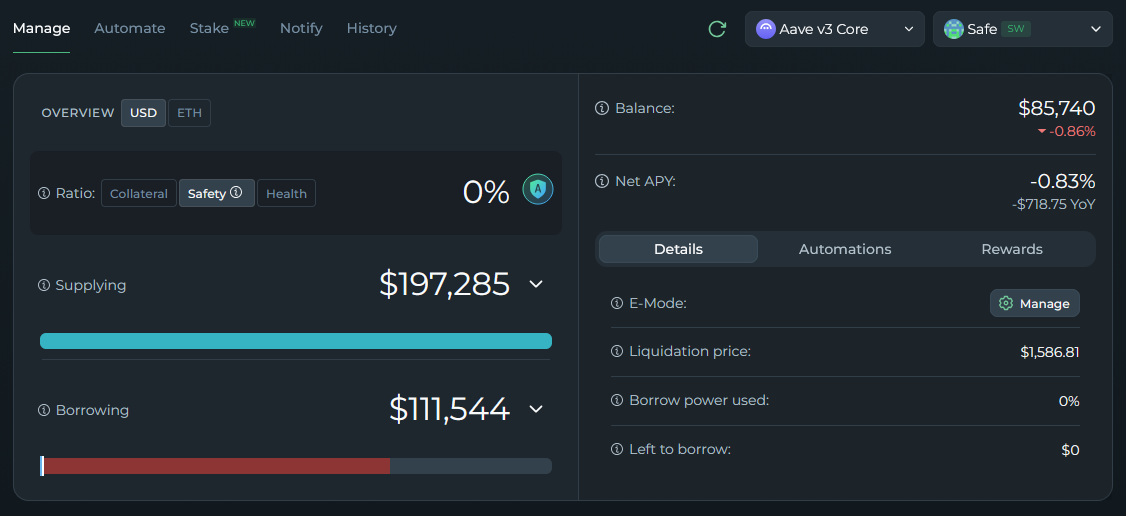
Additionally, since stablecoins have also seen massive outflows from Aave, their utilization is at 100%, too. The result of this are high borrow rates, some of which spiked to double digits.
While this shouldn't be a critical issue for most position, the unexpected costs might be important to some, while liquidation risk can become a thing, too, for very high leverage positions (most notably yield loops with LSTs or yield bearing stablecoins)
In conclusion, you're not in any instant liquidation risk because of the LTV changes. Your position's liquidation threshold is the same as it was before the governance actions, and the only immediate risk you face is the increased borrowing rates and inability to "defend yourself" against a steep price crash of ETH.
The other available options
For those who'd prefer to adjust their position or to completely exit Aave for now, there are multiple paths and tools to consider.
This is mostly thanks to the efforts from Fluid, who have been very quick to introduce the option for aWETH swapping (at size) into assets like wstETH or weETH, as well as 1inch's quick action on supporting these routes in their DEX aggregation.
Collateral switching
Thanks to the mentioned available liquidity for aWETH, collateral switching is now available for Aave positions with ETH collateral within DeFi Saver - both on mainnet and the L2 networks we support.
Collateral switching with aWETH is now available at DFS
— DeFi Saver (@DeFiSaver) April 21, 2026
Starting today, you can do collateral swaps for your @Aave positions with $ETH collateral even while the market is frozen or while market utilization is at 100%.
Traditionally, our collateral switches withdraw the… pic.twitter.com/baORYP9aLh
One important detail to keep in mind is that, unlike our traditional collateral switch, which uses the underlying asset for swaps, this implementation operates exclusively with aWETH. For assets that are at 100% utilisation this is the only possible option, as there's no way to get to that underlying ETH.
Additionally, when selecting the asset you want to switch into, make sure its utilization ratio is below 100%. Entering a fully utilized market can restrict your ability to borrow, adjust, or exit the position and may expose you to unnecessary risk.
The most frequent action we've seen was collateral switching to wstETH, though we've seen a few users who chose to switch to stablecoins, too.
Repaying with aWETH and repaying ETH debt
There are two things to consider here: positions with ETH as collateral and ETH as debt.
For positions that have ETH as collateral, you can now use our Repay (with collateral) option which will also be powered by aWETH liquidity the same as our updated collateral switch options mentioned earlier.
However, there's an interesting thing to consider for positions with ETH debt, too:
The aWETH would usually be trading at peg with ETH itself, because aWETH would be instantly redeemable for ETH. But given the current situation, aWETH is trading at a varying discount.
And thanks to the option of paying back ETH debt using aWETH tokens directly, this makes it potentially lucrative to unwind such positions, while the discount is there.
If you're thinking about taking action, both collateral switching and repaying with collateral are available within our Aave dashboard.
Loan Shifting to a different protocol
If your main concern is the high borrow rates your position is exposed to right now, another option worth considering is our Loan Shifter, the flash loans powered tool that lets you move your position between protocols in one transaction.
For example, what we noticed as early as Sunday was people moving their leveraged staking positions (LST loops such as wstETH/ETH) from Aave to Spark, just like Monet explains in the tweet below.
rates on @aave have risen quite a bit in the past week, making LST loops unprofitable and stablecoin borrows significantly more costly
— monetsupply.eth (@MonetSupply) April 23, 2026
thankfully, the chads at @DeFiSaver have made migrating positions to alternative lending protocols like @sparkdotfi SparkLend easy
here's how-> https://t.co/1XTfxybjNs
Outside of Spark, we have support for multiple other protocols in the Shifter, including Morpho, Fluid, CurveUSD/LlamaLend, and Liquity.
And it's definitely worth noting that this isn't an irreversible process, and you'll be able to move your position back to Aave as soon as you see fit.
Thankfully, it seems that the whole situation is showing signs of progress, with Aave, Lido, and Ether.fi announcing the commencement of DeFi United - an ecosystem-wide recovery effort to prevent bad debt and losses for Aave suppliers.
Aave service providers have been leading the DeFi United effort to restore rsETH's backing since the April 18 incident.
— Aave (@aave) April 23, 2026
We believe ecosystem collaboration matters most in moments like this, and our priority is achieving the strongest possible available outcome for users.… https://t.co/e4fiS6yTxv
Have you any questions or need help managing your Aave positions, please make sure to reach out to our support guys on DFS Discord.
Until the next post, stay safe out there!
Stay connected: